

Why People Watch Days of Speedrunning Without Stopping
Once You Know the Rules, a Game You Never Played Gets Interesting
Speedrunning is picking one game and timing how long it takes from the first frame to the last. The rules change by category. In some you have to collect everything, hidden pieces included, before you finish. In others, skipping anything is fine as long as the clock is short. Same game, different category, completely different contest.
To shave one second off a record, a runner will redo the same stretch hundreds of times. Along the way they find shortcuts the developers never meant to leave in, like clipping through a wall or skipping the intended order of events. It looks like a plain bug the first time you see it, but landing it on demand every single run is another matter entirely.
That is where the fun of watching comes from. Football is much better once you can tell what a player is trying to do, and this is the same. Know what the runner is going for in a given stretch and the hit or the miss is visible even if you have never touched the game. It is also the moment you understand why the room goes quiet when a runner's hand slips.
A Couch on Stage and a Timetable That Runs Through the Night
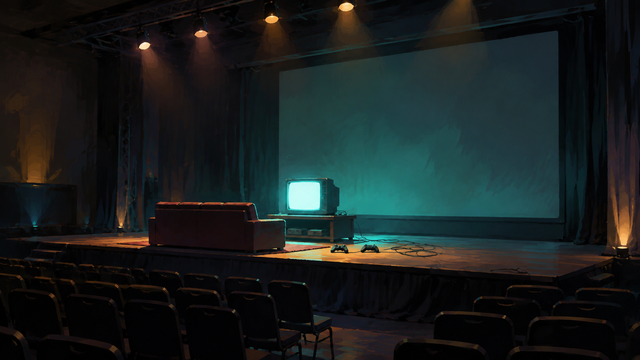
They call it a marathon because it genuinely does not stop for days. There is a couch and a screen on stage, and runners sit down one after another in the order printed on the schedule. When one run ends the next person takes over right away, and it keeps going through the small hours. An audience sits out front, the game is mirrored on a big screen behind, and all of it goes out live.
The timetable is the backbone of the whole thing. Which game, at what hour, run by whom, all of it is published in advance, so you can drop in only for the slot you care about. A very old game can be followed by a recent one, and a solo run can be followed by several people racing side by side. That is why it holds up as something you leave on all day.
Next to the runner sits a commentator. The runner's hands are busy, so they cannot talk for long. The commentator explains instead: why the route goes that way, why this stretch is the hard one. Someone who had never even heard the game's name staying for a full hour is mostly down to these people.
Donations Change What Happens on Screen
These events run on something called donation incentives. Hit a target amount and the runner does another run under harder conditions. Put money behind one of two options and the bigger pile decides what happens inside the game. There are slots where donations even settle what the main character gets named. Because the people watching can actually move what is on screen, the donation page stops being a plain tip button.
Charity fits the format. A broadcast that lasts days needs a reason to stay on, and few reasons beat watching a total climb in real time alongside everyone else. Runners are not there for prize money, and much of the crew is volunteers. Showing off what you can do and raising money end up sharing one stage.
Here are the numbers. Summer Games Done Quick, held from 5 to 11 July this year at the Hilton Minneapolis Downtown in Minneapolis, raised 2,409,821 dollars for Doctors Without Borders. gamescom GDQ, held from 28 to 30 August at Koelnmesse in Cologne, Germany, raised 18,025 euros for Gaming4Democracy. GDQ is short for Games Done Quick, and this was the first time the series ran outside the United States.
The Next One Happens Online
The closest one is Flame Fatales. It starts on 13 September and runs online for a week. There is no stage and no seating, just runners taking turns from their own homes, and it is an event for women and femme runners. The money goes to Malala Fund.
The Frame Fatales banner that Flame Fatales belongs to has raised more than one million dollars for Malala Fund so far. That was not one big haul, it is a number that stacked up a little at a time each year. And from 3 to 10 January next year, Awesome Games Done Quick runs at the Hilton Atlanta in Atlanta. The beneficiary that time is Prevent Cancer Foundation.
Watching it makes you want to time yourself. DoYou Reaction on DoYouBox measures five rounds and averages them, so what comes out is your real speed rather than one lucky tap. DoYou Simon has you memorise a colour sequence and play it back, which is the closest thing here to how runners hold a whole route in their head. Sliding Puzzle takes forever the first time, then after a few boards your hands know which tile to push first. That is exactly why runners redo the same stretch hundreds of times.